
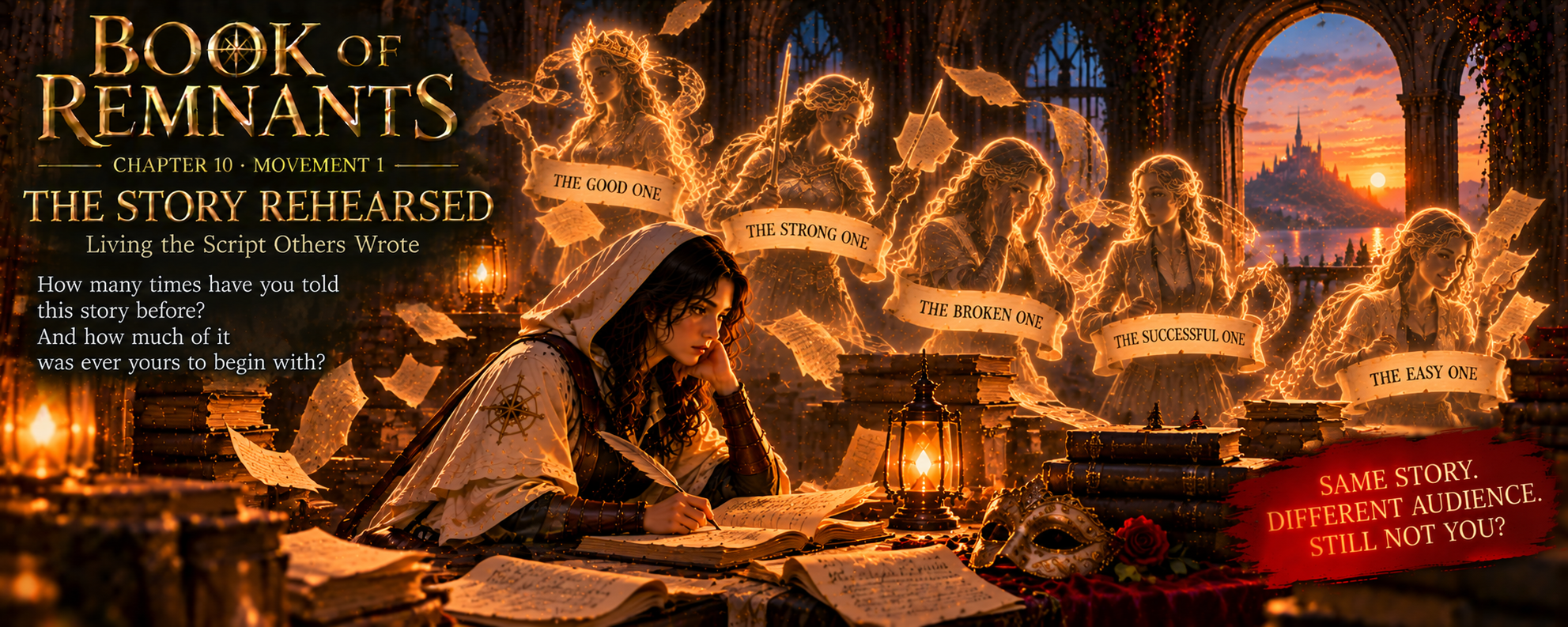
The Story RehearsedThe Keeper of One's Own Mythology
Realm X: Return — Remnant I
The Traveler has become the keeper
of their own mythology —
the one who walked nine Realms,
who crossed every Gate,
who carried every Key,
who arrived at this field
having earned the right to be here.
The story is true.
The holding of it
is the last thing between the Traveler
and the open door.
If you have ever sat next to a forty-five-year-old man at a neighborhood barbecue who still wears his high school championship ring—or a dinner guest who steers every single conversation back to the brutal divorce, the startup collapse, or the grueling ordeal they survived fifteen years ago—you have watched someone trapped inside their own monument.
He sits on the back patio with a cold drink in his hand while the evening breeze moves through the trees.
Within ten minutes of meeting you, he brings out the well-worn album of his defining campaign:
- He recounts the crisis in agonizing, cinematic detail—the nights he slept on the office floor, the betrayal by his former partner, or the year he rebuilt his life from a single suitcase.
- He quotes the exact sentences he spoke when he finally stood his ground.
- He wears the scars, the titles, and the hard-won lessons of that era like rows of brass medals pinned across his chest.
The story is not a lie.
It is completely, undeniably true.
He bled for that survival. He paid for those lessons in sleepless nights and real grief. He earned every ounce of respect that story commands.
Yet watch him as the evening wears on:
He cannot talk about anything else.
He cannot talk about the food on the grill. He cannot listen to a neighbor's ordinary story without topping it with his own campaign. He cannot simply sit in a lawn chair on a warm Saturday evening and be an ordinary person among friends.
He survived the fire fifteen years ago, but he has never actually walked out of the smoke.
He has turned his past survival into a permanent uniform.
He has become the full-time curator, archivist, and tour guide of his own heroic struggle.
He lives inside the memory of what he overcame because without that epic story, he has no idea who is sitting in the chair.
This is the exact trap of the first Remnant of Return: The Story Rehearsed.
It is the fate of someone who has survived real suffering, achieved real mastery, and walked through genuine fire—only to turn the memory of that survival into the ultimate obstacle to their peace.
The story is true.
The holding of it is the last thing standing between them and the open door.
The Seduction of the Earned Narrative
The Remnant of the rehearsed story is the most dangerous of all the traps because it is paved with genuine virtue.
This is not someone who bought cheap spiritual trinkets at an airport gift shop.
This is someone who has done the heavy, terrifying labor of transformation:
- They faced the silence of Origin and saw through their early illusions.
- They submitted to the rigorous, unglamorous chisel of Form.
- They fought the bloody civil wars of Identity and established true boundaries.
- They stood under the lightning of Echoes and heard their unedited truth reflected back.
- They broke their heart open in Compassion and learned to weep for the world.
- They survived the sheer drop of Threshold Fear and stepped onto the swinging bridge.
They have crossed nine Realms. They have paid for every insight with their own tears, sweat, and sleepless nights.
They have earned the right to stand in this field!
And that is precisely why the trap is so deadly: because it is deserved.
When you accomplish something extraordinary—when you break an ancestral cycle of abuse, when you build a business from dirt, when you survive a devastating illness—your ego discovers its most sophisticated hiding place:
It turns your hard-won passage into a holy epic.
You begin to walk through life with an unwritten subtitle running beneath your eyes:
- "I am the one who survived the narcissist."
- "I am the one who overcame poverty through sheer grit."
- "I am the one who did ten years of deep trauma integration."
- "I am the seasoned veteran who knows how dark the world can be."
Every conversation becomes an opportunity to reference the campaign.
Every new challenge is measured against the ancient war.
You cling to the story like an old soldier clutching his tarnished medals, convinced that if you stop telling the story, your sacrifice will have been in vain.
The Hidden Tax of the Mythology
What does it actually cost you to keep rehearsing the story of who you have become?
Look at the mechanics of the narrative:
-
It Keeps You at a Safe Distance from Life
As long as you are viewing yourself through the lens of your heroic past, you never have to be present to the raw, unscripted reality of today. You don't have to meet the stranger across the table as an ordinary, vulnerable human being; you meet them as "The One Who Walked Nine Realms." The myth acts as an elegant, respectable fortress that keeps real life from touching your heart. -
It Requires Constant Defense
A mythology is a fragile, artificial construct. If someone questions your wisdom, dismisses your experience, or treats you like an ordinary fool, you feel an irrational, burning fury in your chest. Why? Because your sense of self-worth is invested in the legend. You are forced to spend immense energy defending your pedigree, reminding people of what you have been through, and proving that you have earned your seat at the table. -
It Forbids You from Entering the House
Look at the house standing at the edge of the field. Look at the open door. The door is narrow. It is the height of an ordinary human being. You cannot walk through that door while wearing a five-pound helmet of spiritual pride and five rows of heavy medals across your chest. To enter the house, you must take off the dress uniform. You must hang the medals on a peg in the hallway and walk into the kitchen as nobody in particular.
And that is the one thing the keeper of the mythology refuses to do.
The Tragedy of the Professional Survivor
There is a tragic, modern phenomenon we see everywhere today: the person who has made a full-time career out of being a survivor.
Their entire identity—their social circle, their public platform, their vocabulary, their daily routine—is organized around the trauma they endured fifteen years ago.
If you were to offer them complete, total, irreversible healing—if an angel appeared and offered to wipe away the psychological pain entirely, leaving them free, light, and unburdened—they would secretly hesitate.
Why?
Because if the wound is healed, the story ends.
And if the story ends, who are they?
What will they talk about at dinner? What will they write about on the internet? How will they explain their flaws, their boundaries, and their special status?
To heal completely means surrendering your victimhood and your heroism in the same breath.
It means stepping off the stage of your grand drama and returning to the quiet, unglamorous anonymity of an ordinary mortal life.
How to Retire the Myth
Setting down the story of your passage does not mean dishonoring what you survived; it means allowing the war to finally end:
1. Stop Dropping Your Resume into Conversations
Notice how often you mention your past struggles, achievements, or credentials to justify your opinions:
- Catch yourself before you cite your background: "As someone who has walked through..."
- Cut the preface entirely.
- Speak your thought plainly, from your immediate perception right now, without propping it up with your historical resume.
If your words have truth in them, they will stand on their own legs today. They do not need a letter of recommendation from your past.
2. Declare an Amnesty on Your War Stories
For the next seven days, banish all recounting of your grand breakthroughs and terrible ordeals:
- Do not tell the story of your divorce.
- Do not tell the story of your corporate burnout.
- Do not tell the story of your spiritual awakening.
Treat those events as if they happened to a different person three hundred years ago.
Live strictly in the uncaptioned present:
- How does the tea taste right now?
- What does the wood grain under your palm feel like?
- What does the person in front of you actually need in this ten-second window?
Notice how strange, quiet, and light the world feels when you aren't carrying the archive on your shoulders.
3. Unpin the Medals in Secret
Go into your bedroom or workshop alone:
- Close your eyes and bring your entire personal history of struggle to mind—all the victories, all the scars, all the hard-won insights.
- Say to that history with deep, unyielding respect: "You were real. You built this skeleton. You brought me to this field. Thank you."
- And then say: "And now your shift is over. I am relieving you of duty."
Picture yourself unpinning the medals one by one and laying them on a clean wooden shelf.
Take off the heavy dress uniform.
Stand in your simple, unadorned shirtsleeves in the cool air.
The Light Beyond the Legend
The house at the end of the field does not need a legendary hero.
The hearth inside is not burning for an epic character in a spiritual history book.
It is burning for a tired traveler who has finally had the courage to stop being interesting.
The door is standing open. The yellow lamp is burning in the window. The grass is wet with the dew of dawn.
Leave the mythology in the field.
Let the history books stay in the dirt.
Walk up the wooden steps with empty pockets, an unpinned chest, and an open hand—and step through the door into your own kitchen.