
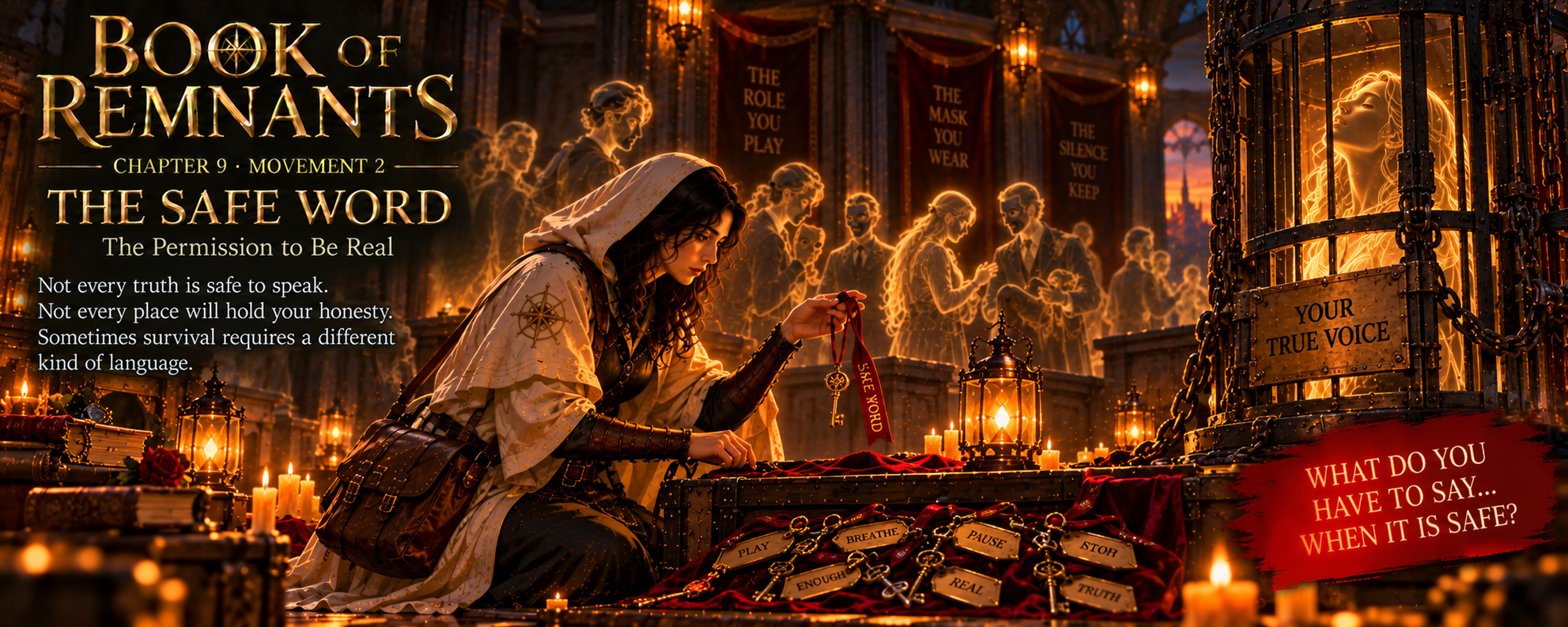
The Safe WordLanguage That Keeps Distance Intact
Realm IX: Threshold Fear — Remnant II
The Traveler speaks.
Nothing moves.What is offered has been chosen for its safety rather than its truth —
words that will land softly, that will not require anything in return,
that will keep the distance exactly as it is.
If you have ever received a three-page holiday newsletter from a family that you know is in the middle of a bitter divorce, or sat through a forty-five-minute conversation where two old friends talked non-stop about restaurant recommendations and traffic routes to avoid mentioning the betrayal sitting between them, you have witnessed a masterclass in linguistic padding.
There is plenty of noise in the room.
Words pour across the table. Warm smiles are flashed. Laughs are exchanged on cue. Questions are asked and answered with brisk, cheerful fluency.
Yet when the bill arrives and everyone stands up to put on their coats, you look at the actual space between those two people.
Not a single honest fact has been touched. Not a single bruise has been acknowledged. Neither person has moved an inch closer to the other.
There was sound. There was warmth. There was the theatrical appearance of human conversation.
But every sentence was packed in three inches of foam rubber before it left the mouth.
Nothing landed with real weight. Nothing was risked, and therefore nothing moved.
This is the exact mechanism of the second Remnant of Threshold Fear: The Safe Word.
It is the tragedy of someone who uses language not to bridge the distance between two human souls, but to fortify the moat between them.
The Traveler speaks.
Sentences leave the mouth. Words fill the room. Smiles are exchanged.
And absolutely nothing moves.
The Anatomy of the Linguistic Moat
We all know the devastating power of the safe word. Most of us speak them three dozen times a day without noticing the cowardice behind our teeth.
Consider the classic, heartbreaking scene between two colleagues who have worked side-by-side at a key station for eight months:
- A woman gathers her courage, looks away from her work, and speaks a small, trembling invitation into the quiet: "You know... we should hang out sometime. Outside of work."
- Her voice is slightly unready. The edge of real connection has suddenly materialized in the middle of a fluorescent-lit room.
- The man's heart thuds hard against his ribs. His nervous system registers the threshold: this is real. This is an invitation to be seen, to be known, to risk rejection or intimacy.
- He has a true response waiting in his chest: "I would love that. I have wanted to ask you for months."
- But the true response is dangerous. It leaves him naked. It requires commitment. It offers a hostage to fortune.
So, in a fraction of a second, his internal defense system steps in and substitutes the safe word.
He smiles lightly—too lightly—and says: "Yeah, totally! We should get the whole crew together."
Notice the surgical, lethal precision of that sentence:
- It sounds friendly.
- It sounds agreeable.
- It cannot be accused of being hostile or rude.
Yet it operates as a high-caliber deflector shield.
By adding the words "the whole crew," he instantly dilutes the intimacy of two people into the safe, sterile soup of group dynamics.
He kills the romantic possibility without having to muster the courage to say "no."
The woman deflates. "Oh. Yeah. Sure. That could be fun."
She turns back to her keys. He turns back to his keys.
The moment, which had been warm, soft, and electric with possibility, shrivels like a salted slug and dies on the floorboards.
He drives home later that night telling himself he was just being polite, just being friendly.
He was not being friendly.
He was wrapping the moment in bubble wrap so nothing real could touch him.
The Catalog of Counterfeit Currency
The safe word is the counterfeit currency of human relationships.
It is designed to buy you the social credit of being pleasant without requiring you to pay the gold coin of genuine vulnerability.
Look at the standard catalog of safe words we deploy every day:
-
"We should definitely catch up soon!"
Spoken on a street corner to an old friend you haven't seen in three years. You don't pull out your calendar. You don't set a day. You speak the sentence with exaggerated warmth specifically to conclude the encounter without having to admit that your paths have permanently diverged. -
"I'm just so busy right now."
The ultimate modern safe word. It replaces the terrifying, honest boundary—"This project does not align with my values," or "I do not want to spend my weekend with your friends"—with an impersonal, socially unimpeachable excuse. Nobody can argue with "busy." It protects you from having to take ownership of your choices. -
"That's an interesting perspective."
Spoken in a meeting or dinner party when someone says something you find morally repulsive or completely foolish. You use the phrase to sound diplomatic, open-minded, and wise—while secretly sneering at the speaker and refusing to risk the friction of taking a real stand. -
"I'm fine, just tired."
The universal shield against intimacy. When your spouse or friend looks into your eyes and asks what is wrong, you throw this scrap of raw meat to their concern so they will stop looking beneath your floorboards.
Every single one of these phrases has been chosen for its softness.
They land like goose-down pillows. They make no sound. They require nothing in return.
And they ensure that the distance between you and the other person remains exactly, permanently what it was.
The Somatic Cost of the Safe Word
You cannot speak safe words without your physical body registering the lie:
- The Glancing Eye: Watch your eyes when you deliver a safe word. You will almost never maintain direct, steady eye contact. Your gaze will flick to the side, to your wristwatch, or down to the floorboards right as the dishonest syllable leaves your lips.
- The Pitch Shift: The voice pitched half an octave higher than your natural chest resonance. The safe word is delivered with a false, musical lilt designed to disarm the listener and signal harmlessness.
- The Dead Throat: After a day of speaking safe words, your throat feels scratchy, dry, and tight. You have been swallowing your real sentences all day long, choking your own truth back down into your gut.
The body hates the safe word. The body knows that every time you speak a coward's phrase, you diminish your own standing in the real world.
How to Speak the Weighty Word
Replacing the safe word with the truthful word does not require cruelty or blunt aggression; it requires the courage of plain speaking:
1. Strip Out the Cushions
Notice the diplomatic padding you instinctively wrap around your sentences:
- "I was just kind of wondering if maybe we could possibly..."
- Strip the sentence down to its bare, load-bearing timber: "I want to talk about our contract."
- If the answer is no, say: "No, I cannot do that." Do not add three paragraphs of fake excuses about your calendar.
A clean, honest "no" is an act of profound respect. A cowardly, padded "maybe" is a slow poison.
2. Answer the Personal Invitation with Equal Weight
When someone takes the risk of stepping toward you—whether in love, in friendship, or in business—honor their courage by meeting them at the edge:
- If they say: "We should hang out sometime," and you want to see them, do not say "Totally!"
- Look them in the eyes and say: "I would love that. Let's get dinner this Thursday. Are you free at seven?"
- If you do not want to see them, say with gentle, unyielding clarity: "I appreciate the offer, but I don't think that makes sense for us right now."
Give them a plain, solid answer.
Refuse to toss foam padding into the air.
3. Catch the "I'm Fine" at the Teeth
The next time someone asks you how you are doing, catch the automatic, safe response behind your teeth:
- Hold your tongue for two full seconds.
- Check the real weather in your chest.
- If you are grieving, say: "I am having a very difficult week."
- If you are furious, say: "I am wrestling with a lot of anger today."
You don't need to give them a three-hour monologue.
Just give them one single coin of real currency.
Watch how quickly their face softens, and how the sterile distance between you dissolves into authentic human solidarity.
The Word That Moves the World
Language was not given to human beings to camouflage their fear.
Language is the bridge across which one solitary life actually reaches another.
A true word, spoken without padding and without apology, has physical mass.
It crosses the table with real weight. It lands in the chest of the listener. It cuts through the polite noise, drops the false pretense, and creates an opening where two people can finally meet in the daylight.
Stop filling the room with polite noise.
Stop packing your truth in cheap styrofoam.
Open your throat.
Let the safe word die in your mouth—and speak the heavy, terrifying, beautiful truth that actually moves the world.