
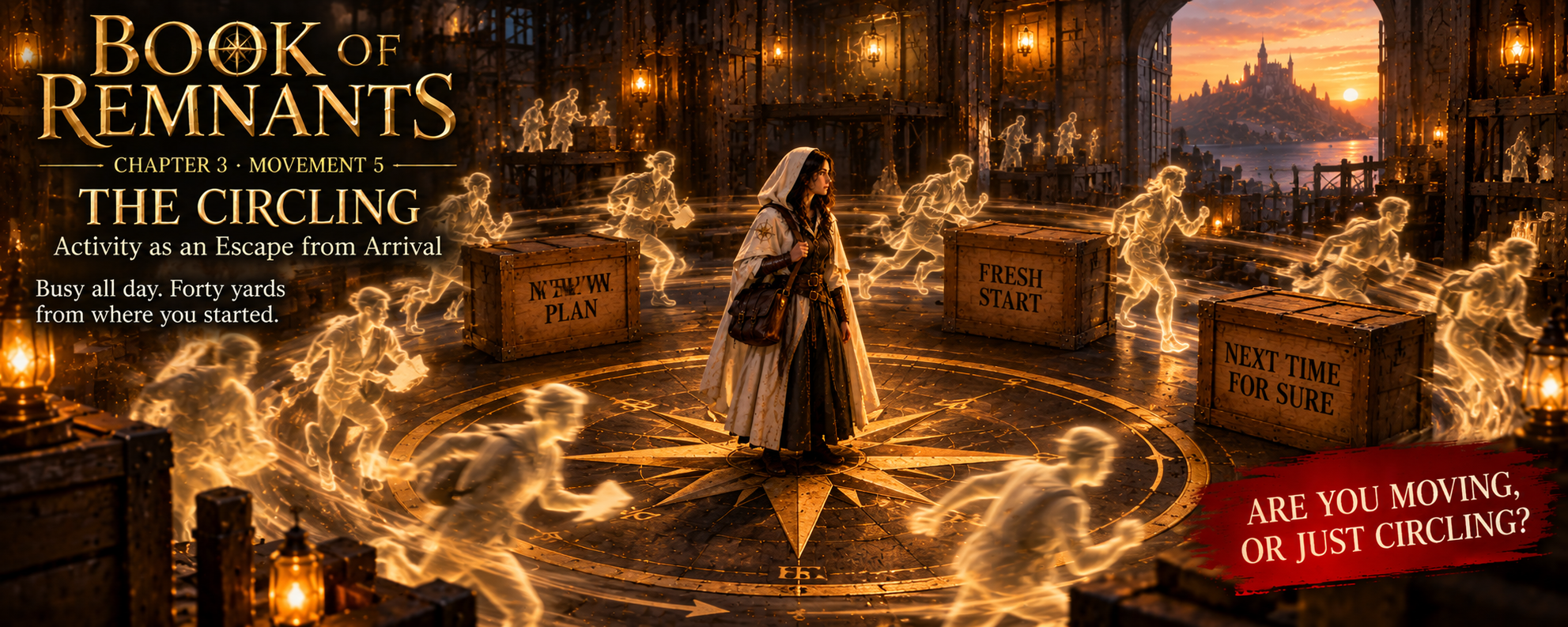
The CirclingActivity as an Escape from Arrival
Realm III: Identity — Remnant V
Movement replaces direction.
Choice replaces orientation.
Noise replaces knowing.The Traveler moves through every current
with the conviction that the next one will finally be the right one —
and the moving itself becomes the way of never having to arrive.
If a sailing ship enters a heavy fog bank without a working magnetic compass, an inexperienced captain will often do something frantic: they will refuse to stop the ship.
The fog is dense and gray, pressing in from all sides until the horizon disappears. The captain cannot see the stars above or the shoreline ahead. The silence of the fog feels eerie, suffocating, and terrifying.
Unable to endure the stillness, the captain begins shouting orders.
They set the mainsail. They tack hard to the east. Five minutes later, feeling uneasy about the wind, they bring the helm around and steer south. Then they adjust the jib, haul the lines, and head west.
The ship is cutting through the swells at seven knots. The bow throws up white spray. The crew is drenched in sweat, pulling ropes, hauling canvas, and adjusting the rigging. Everyone on board feels completely absorbed in urgent, productive work.
If you asked the captain what they were doing, they would say they were making aggressive headway.
Now look down at the navigation chart.
Because the ship has no fixed reference point, every turn was an unanchored guess. The vessel has spent the last four hours carving tight, frantic circles in the open water. It has burned half its provisions, exhausted the crew, and ended up exactly forty yards from where it started.
The movement was real.
The direction was a complete illusion.
The Fifth Remnant of Identity diagnoses that exact human tragedy:
Movement replaces direction. Frantic choice replaces orientation. And the moving itself becomes the covert strategy for never having to arrive.
The Addiction to the Starting Line
We live in a culture that mistakes restlessness for ambition.
We celebrate the person who is always launching something new, always pivoting, always packing their bags, and always embarking on the next grand adventure.
Notice the pattern of the chronic circler:
- The Career Hopper: They spend two years in a field, achieve the initial burst of competence, and then hit the wall where mastery requires grinding, unglamorous repetition. The moment the work becomes tedious, they experience a sudden "revelation" that this was never their true calling. They quit, rebrand themselves, and start at the bottom of an entirely new industry with missionary zeal.
- The Geographic Wanderer: They believe their unhappiness is caused by the city they live in. If they live in Seattle, they move to Austin. If they live in Austin, they move to a cabin in Vermont. With each move, the first three months feel intoxicating and fresh. By month six, the familiar gray cloud settles back over their shoulders, and they begin browsing real estate listings in Portugal.
- The Philosophy Consumer: They practice Zen meditation for six months until sitting quietly feels too boring. Then they switch to Stoicism and buy five leather-bound journals. Then they move to breathwork, then to intense physical training, then to esoteric philosophy. They adopt the vocabulary of each new system with total fluency, preaching its gospel to their friends, only to drop it the moment it demands real sacrifice.
Every time they change currents, they feel an absolute conviction: "This is the one. This is finally who I am."
And they never notice that they have spent twenty years standing at the starting line.
The Secret Function of the Circle
Why do people trap themselves in this exhausting loop?
Because arrival is terrifying.
As long as you are moving, you are insulated from reality:
- You never have to be judged. A beginner can never truly fail. If a project is only three months old, any flaw can be excused as "early iteration." If you never stay in one place long enough to build a twenty-year body of work, you never have to face the agonizing question of whether your work was actually good.
- You never have to be known. In a new city or a new relationship, you can present your curated, idealized self. The other person only sees your charm, your intelligence, and your potential. It takes two or three years of daily proximity for your selfishness, your pettiness, and your deepest flaws to become visible. The circler leaves right before the mask slips.
- You never have to endure boredom. Mastery in any human endeavor—a craft, a marriage, an art, a community—is seventy percent ordinary maintenance. It is sweeping the shop floor, having the same patient conversation for the tenth time, and showing up when you don't feel like it. The circler is terrified of that quiet maintenance because in the quiet, the voice of their own emptiness starts speaking.
The frantic movement is not a quest for identity.
The frantic movement is an elaborate, exhausting fortress built to keep the person from ever having to sit in a room alone with themselves.
The Anatomy of the Pivot
Notice what happens right before the circler changes course:
The honeymoon period of the current project fades. The initial excitement evaporates. The daily grind sets in.
Suddenly, an obstacle appears: a difficult conflict with a colleague, a technical problem that takes three months of grinding effort to solve, or a deep feeling of personal inadequacy.
At that exact second, the circler's brain goes to work.
It doesn't say: "I am running away because this is hard."
It invents an elaborate, high-minded philosophical justification:
- "I have outgrown this environment."
- "My values no longer align with this mission."
- "The universe is telling me it's time to transition."
They wrap their cowardice in the language of growth.
They drop the paddle, jump into another current, and celebrate their own "courage" while their life continues to drift in circles.
How to Drop Anchor and Arrive
You cannot break the circle by choosing a better current.
You break the circle by dropping the anchor into the mud and refusing to move:
1. Commit to the Five-Year Horizon
Pick one central endeavor in your life—your vocation, your primary relationship, or the place where you live—and make an unconditional covenant:
"I am staying here for five years. I will not reconsider this decision until the clock runs out."
Taking the option of running away off the table changes your psychology completely.
When you know you cannot pack your bags at the first sign of friction, you are forced to solve the problems in front of you. You have to learn how to forgive, how to negotiate, how to master difficult skills, and how to repair what is broken.
2. Endure the Winter of Boredom
When the initial novelty of a path dies down and the gray, repetitive days arrive, do not reach for a new book, a new hobby, or a new plan.
Recognize the boredom for what it is: the threshold of depth.
Shallow waters are always turbulent and splashy. Deep waters are dark, cold, and slow.
Sit at your desk. Pick up the same tool. Do the unglamorous, unrewarded work of the day without looking for applause.
3. Meet the Person in the Room
The next time you feel the frantic itch to pivot, sit down in a straight-backed chair, face an empty wall, and set a timer for thirty minutes.
Do not move your feet. Do not check your phone.
Notice the panic that rises in your throat. Notice the voice telling you that you are wasting time, that you need to be doing something productive, that you need to change your life right now.
Let the voice shout. Do not obey it.
Look at the empty wall. Feel your ribs expand and contract.
Meet the mortal, imperfect, fragile human being who has been running for decades to avoid this exact moment.
The Peace of Standing Still
You do not need another current.
You do not need another system, another city, another degree, or another complete reinvention.
The ground you are standing on right now is real. The tools on your bench are sufficient. The people in front of you are enough to love for a lifetime.
Put the helm amidships.
Let the sails fall to the deck.
Drop the heavy iron anchor through the fog into the deep sand, and let the hull come to rest in the quiet water.