
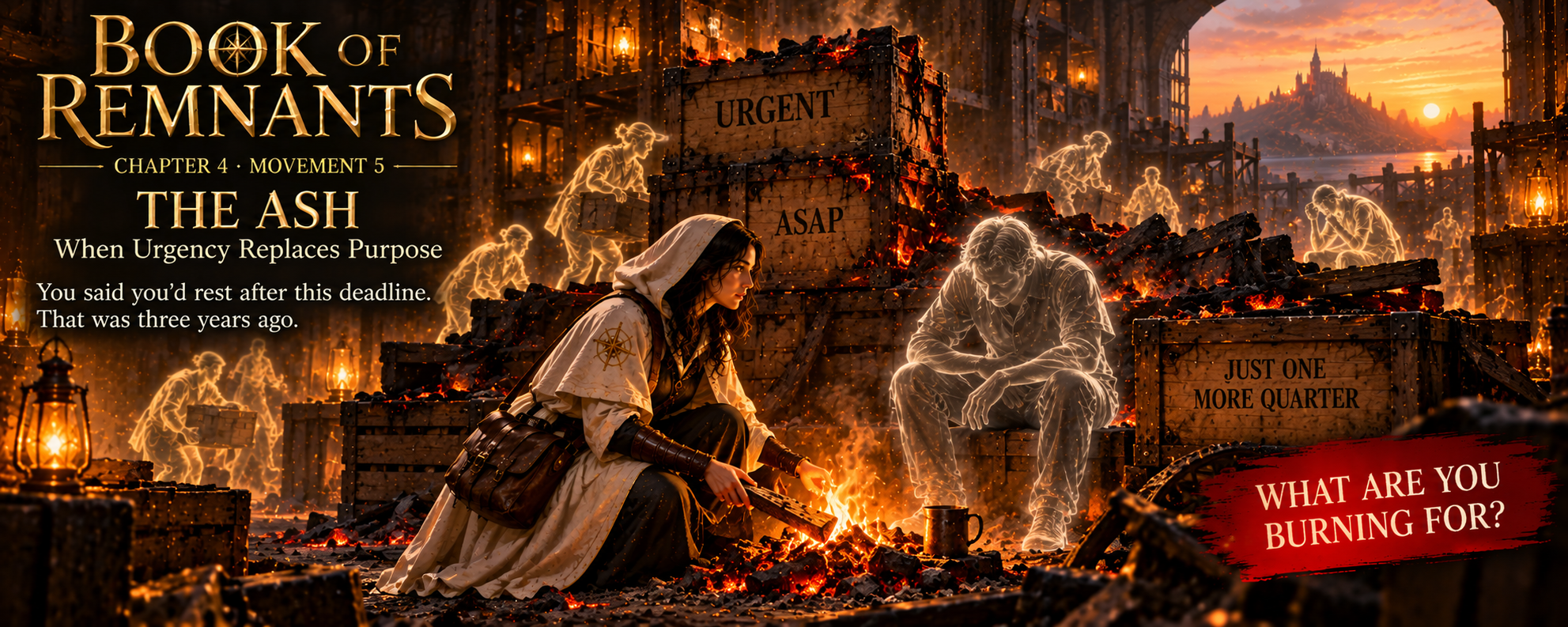
The AshWhen Urgency Replaces Purpose
Realm IV: Will — Remnant V
The fire, which had no centre,
consumes even the one who lit it.Intensity becomes ruin when urgency replaces purpose —
when the Traveler burns so hot, so fast,
giving everything to the motion
without ever pausing to ask if the motion is the point.
If you have ever driven an older car up a steep summer highway pass with the air conditioning blasting, you know what happens when you ignore the red temperature warning light on the dashboard.
At first, the car still pulls hard when you press the gas pedal to the floor.
The engine roars at four thousand revolutions per minute. You pass the slower trucks in the right lane. Everything feels fast, capable, and under your command.
By mile six, the temperature needle is buried past the red line, and a sweet, hot smell of boiling antifreeze begins seeping through the dashboard vents.
If you keep your foot pressed to the floor anyway—telling yourself you just need to make it over the summit before you pull over—the oil inside the engine thins out to nothing. Bare metal begins grinding against bare metal. A sharp, metallic knocking starts under the hood.
And then, with a violent shudder that shakes the steering wheel in your hands, the engine locks up solid.
Thick white steam pours from the edges of the hood. The power steering goes dead. You coast helplessly onto the gravel shoulder in silence.
You cannot wait ten minutes and turn the key again. Once an engine has run dry and seized from its own heat, the metal inside has welded itself together into an immovable block of scrap iron. It ran so hot and so fast that it destroyed the very machinery that made movement possible.
Almost everyone has witnessed a human being do the exact same thing to their own body and spirit.
We call it burnout, but "burnout" is far too mild a word.
What actually happens is catastrophic systemic failure:
A capable, dedicated person enters a high-pressure role or takes on an impossible mission. They work eighty hours a week. They survive on four hours of restless sleep, three cups of black coffee before noon, and a glass of whiskey before bed.
They tell themselves this is temporary. They tell themselves that once they get through this next deadline, this next quarter, or this next promotion, they will finally rest.
Years pass. The pace never slows. In fact, it accelerates.
The person prides themselves on being indestructible. They wear their exhaustion like a medal of honor.
And then, one Tuesday morning, the engine seizes.
They sit on the edge of their bed, staring at their shoes, and they realize they cannot stand up. Their limbs feel like wet sand. Their mind, once sharp and analytical, cannot form a coherent sentence. They look at their children and feel nothing—no anger, no grief, just a flat, terrifying gray numbness.
The fire, which had no center, has consumed the very person who lit it.
The Fifth Remnant of Will delivers this grave, unflinching verdict:
Intensity becomes ruin when urgency replaces purpose. When we burn so hot and so fast that we give everything to the motion, without ever asking if the motion is the point.
The Deception of the Redline
Why do smart, capable people drive themselves into the ash heap?
Because our culture has completely decoupled motion from meaning.
We live in an economic machine that worships speed for speed's sake. We celebrate the founder who sleeps under their desk, the executive who answers emails at three in the morning from a hospital bed, and the worker who hasn't taken a vacation in five years.
Notice how the trap snaps shut:
- Urgency Usurps Purpose: In the beginning, you worked hard because you cared about a specific outcome—feeding your family, mastering a craft, or building a school. But as the speed increases, the original purpose is forgotten. The daily emergency becomes the entire focus. You stop asking why you are doing the task; you only care about getting it off your desk before five o'clock. The adrenaline rush of handling crises replaces the deep, quiet satisfaction of purposeful work.
- The Vessel Is Treated as Disposable: You begin to treat your biological body like an annoying pack mule that must be beaten with stimulants to keep running. You ignore the pain in your stomach, the tension in your jaw, the chronic insomnia, and the racing pulse. You treat your physical warning lights as character defects to be overridden by willpower.
- The Loss of the Center: A hearth fire has a center—a stone base, a chimney, and a steady supply of well-cured hardwood. A centerless fire has no container. It burns whatever is nearest. You burn through your family's trust, burn through your friendships, and finally, having nothing else left to throw on the flames, you burn your own nervous system.
You gave everything to the motion.
And you never noticed that the motion was running in a circle on top of a treadmill that goes nowhere.
The Anatomy of the Ash
What does it feel like when the fire burns out?
It does not feel like sadness. Sadness is an active, living emotion that has tears and warmth.
The ash feels like dead stone:
- Anhedonia: You can look at a glorious mountain sunset or listen to your favorite piece of music, and it produces zero resonance in your chest. The acoustic chamber of your heart has been scorched flat.
- Cognitive Fog: You can read a paragraph four times and have no idea what it said. The cognitive energy that once juggled complex systems is reduced to survival tasks: breathing, chewing, and staring at a wall.
- Cynicism: You look at the people around you who are still running hard, and you feel only a bitter, exhausted contempt. You believe that all ambition is a con, all love is a transaction, and all effort is pointless.
You have become the seized engine sitting on the side of the highway while traffic roars past.
How to Rebuild from the Ash
If you find yourself standing in the ash—or if you can smell the oil burning in your own engine right now—you cannot fix the problem with another burst of willpower.
You cannot force an ash heap to glow.
You have to change your relationship with energy from the ground up:
1. Drop the Throttle to Idle Immediately
If the engine is overheating, you don't downshift and step on the gas.
You pull over onto the shoulder, push in the clutch, and let the machine idle.
Cancel the non-essential commitments. Decline the new invitations. Turn off the notifications on your phone.
Tell the people in your life the plain, unadorned truth: "I am at the redline. If I don't stop right now, I am going to collapse."
Expect to feel a profound wave of guilt and panic. The adrenaline addiction will scream that you are falling behind, that everything will fall apart without you.
Let it scream. The world managed to spin for four billion years before you arrived; it will survive forty-eight hours without your emails.
2. Honor the Animal Body
You are not an abstract thinking machine floating in cyberspace. You are a biological organism made of blood, bone, muscle, and breath.
Stop trying to lead a revolution when you haven't eaten a vegetable or walked in the sun in four days:
- Drink water until your throat is clear.
- Go to sleep at nine o'clock, even if you just lie there in the dark.
- Walk three miles through the trees without earbuds, letting your eyes rest on the horizon.
- Eat simple, warm food with your hands, chewing slowly without a screen in front of your face.
You have to give the metal time to cool and the oil time to settle back into the pan.
3. Find the True Center Before You Strike Another Match
Do not light another fire until you have built a proper hearth.
Before you take on another project, another role, or another grand ambition, sit before the cold stone and ask:
"What is the single thing that is actually worth my mortal life?"
Not ten things. Not twenty goals on a vision board.
One thing.
Is it raising your children to be whole, grounded human beings? Is it practicing your craft with uncompromising integrity? Is it being a faithful, loving partner to the person who shares your bed?
Find that center. Build the hearth walls around it.
And swear an unbreakable oath to yourself: Nothing will ever enter this fire that requires me to burn down the house to keep it lit.
The Peace of the Controlled Burn
Will is not the ability to destroy yourself in a blaze of glory.
Any fool can pour gasoline on their own life and strike a match.
True will is the discipline to keep the fire inside the hearth—steady, warm, and sustainable—so that it can burn for eighty years without consuming the vessel that holds it.
Step away from the redline.
Take your foot off the floorboard and let the hot metal cool.
Sit in the quiet shade of your own limits, where the fire stays inside the hearth and the house stays standing.